
We’ve had a really busy few months getting new products finished, tested, inspected, repackaged, and ready to ship.
A lot of these parts have been in development for a long time, and we’re excited to finally start getting them into your hands. Over the past couple weeks, we’ve dropped several new Terache products, including new Aztex XL sizes, Honda HD ball joints, forged gear reductions, upgraded clutches, and new axle options for Honda and Can-Am platforms.
There’s a lot to cover, so let’s get into it.
28x9.5x12 Aztex XL Tires
One of the first new products we released was the 28x9.5x12 Aztex XL.
This is a tire people have been asking for forever.
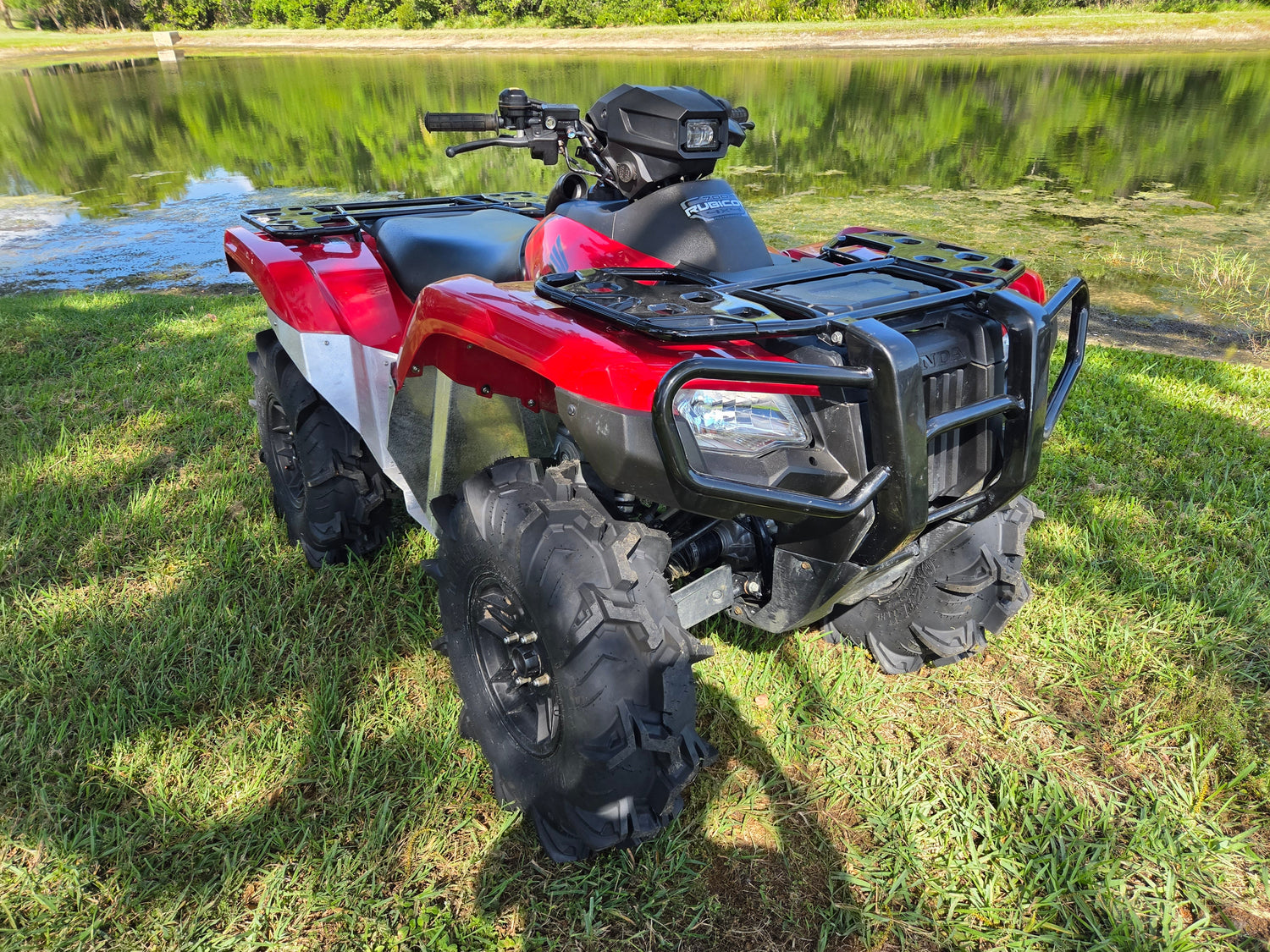
It’s currently the only Aztex tire we offer that works with stock ATV wheels, since it fits a 12-inch wheel. We also made it the right width to work well on both skinnier front wheels and wider rear wheels, which is important because most ATVs and smaller UTVs run a wider wheel in the rear.
That makes this size a big deal for riders who don’t want to spend money on aftermarket wheels but still want the traction and performance of the Aztex XL.
 The new 28x9.5x12 Terache Aztex XL brings Aztex traction to stock 12-inch ATV wheels
Of course, as soon as we released this size, people started asking for more.
We’ve already had requests for 25s, 26s, and even 30s on a 12-inch wheel. We’re looking into those requests, but we probably won’t make a 30-inch version for a 12-inch wheel. We already offer 30-inch options for 14-inch wheels, and that’s a better setup.
A 30-inch tire on a 12-inch wheel has a lot of sidewall. That can reduce stability and create too much buoyancy, which makes the machine harder to control in deep water.
Terache HD Honda Ball Joints
Another new product we released is our Terache HD ball joints.
These solve a lot of the problems riders run into with OEM Honda ball joints, especially once they start running larger tires.
Honda OEM ball joints are made from aluminum. That works fine on smaller factory tires, but once you start stepping up to 30s, 32s, and larger mud tires, the aluminum can become a weak point. We’ve seen OEM ball joints shear, pull out of the control arm, and fail under heavy use.
They can also be frustrating to install because the soft aluminum is easy to damage when pressing the ball joint into place.
Our HD ball joints are built from chromoly steel and use a lock-on design instead of a snap ring. A threaded collar keeps the ball joint secured, helping prevent it from getting pulled out under load.
We also included heavy-duty rubber boots with spring clamps.
That matters because keeping mud and water out of your ball joints is the only way to make them last. A lot of aftermarket ball joints, even expensive ones, use weak boots held on by small zip ties or nothing at all. We wanted ours to be tougher from the start.
We also include the tools needed to install them, which is a big deal because most off-the-shelf ball joint kits don’t include the right tools for these Honda ATV applications.
60% Forged Billet Honda Gear Reduction
The next major release is our new 60% forged billet gear reduction.
This is a big upgrade over our previous gear reduction, and as far as we know, no one else has made forged gears for the Honda ATV platform like this.
Forged gears are usually something you see in higher-end automotive applications, performance Can-Am builds, and other serious drivetrain parts. When we developed our forged Can-Am G3 gear reductions, we got very comfortable with the forging process and started asking a simple question:
Why not bring that same technology to Honda?
So we did.
Forging takes more time, more tooling, and more money. You can’t just start with a billet block and machine everything down. You have to create a custom forging mold, form the gear blank under heat and pressure, and then machine the teeth, splines, and final details afterward.
The benefit is strength.
Forging helps align the grain structure of the steel in a way that works extremely well for gears. That gives us a stronger base material before the final machining and heat treatment even happen.
With these forged gears, we also have more freedom to fine-tune the tooth profile and relief cuts. That helps us get smoother gear mesh while keeping the strength where it needs to be.
After machining, the gear teeth and splines are heat treated for surface hardness and wear resistance.
That’s why Terache gears are so smooth, strong, and reliable.
Billet Clutch Basket Upgrade
The new gear reduction also includes a billet clutch basket.
The basket is machined from 6061 billet aluminum, giving it a precise fit and a clean, high-end finish. We’ve also started riveting the basket assembly together just like Honda does from the factory.
That means no more tapped holes, bolts, and Loctite holding the basket together.
This is a cleaner, more professional, factory-style assembly, and it makes the whole gear reduction package feel like a serious upgrade from start to finish.
Terache HD Clutches
To go along with the new gear reduction, we also released our Terache HD clutches.
These clutches are designed with increased holding power to handle the added stress that comes from running a gear reduction.
A lot of people don’t realize this, but a gear reduction increases torque before the disc clutches. Depending on the reduction, the clutches can see 35% to 60% more torque. Add big tires, thick mud, and aggressive riding, and the stock clutches can start slipping.
Our HD clutches use friction material with a higher coefficient of friction, which helps them bite harder and hold better under heavy load.
We are not planning to make centrifugal clutch shoes because the centrifugal clutch sits before the gear reduction. Since the torque multiplication happens after it, the centrifugal clutch usually sees less torque, not more.
So for now, the focus is on the disc clutches where the extra holding power is actually needed.
Honda Rincon, Rincon 650, and Rubicon 700 HD Axles
We also released new HD axles for the Honda Rincon 680, Honda Rincon 650, and Honda Rubicon 700 platform.
These are a huge upgrade over OEM.
The front axles have much better operating angles, which helps prevent the axle shaft from rubbing the CV cup. That rubbing is a common issue with OEM and some aftermarket axles, especially once you add a lift kit.
When the shaft rubs the cup, metal gets into the joint, and eventually the inner joint can fail.
Our front axles are built to give more angle and more clearance.
The rear axles are also upgraded with chromoly steel construction. We couldn’t make the rear shafts dramatically larger in diameter because of clearance concerns with lift kits and control arms, but they are still built from much better material than OEM and designed for improved durability.
We’ve been running these axles on our own test unit with different bracket lift setups and have had zero issues. We’ve also tested up to 32-inch Aztex tires on the Rincon 680 and Rubicon 700 platform.
They’ve held up great.
Gen 3 Can-Am Axles
The next axle release coming up is our front axles for the Gen 3 Can-Am platform.
We already have the rear axles on the market and have been testing them on our Can-Am XMR 1000 test unit.
The rear axles fit all new Gen 3 Can-Am models, including:
- 500
- 700
- 850
- 1000
The front axles are more model-specific. The 850 and 1000 models use longer front axles than the 500 and 700 models, so we’re making sure each version is built correctly for the platform.
More New Products, More Testing, More Riding
This has been one of the busiest product release stretches we’ve had.
Between the new 28-inch Aztex XLs, HD Honda ball joints, forged Honda gear reductions, billet clutch baskets, HD clutches, Honda axles, and upcoming Gen 3 Can-Am front axles, we’ve had a lot going on behind the scenes.
But that’s the goal.
We want to keep building parts that solve real problems for riders: better traction, stronger drivetrains, smoother gear reductions, tougher suspension parts, and products that are actually tested in the mud before they ever ship.
Everything we’ve released recently has been inspected, tested, packaged, and is ready to go.
We’re excited to finally get these parts out to you guys.

0 comments